

Synastry Compatibility: How Relationship Astrology Works in Western Astrology and Kundali Milan in Vedic Astrology
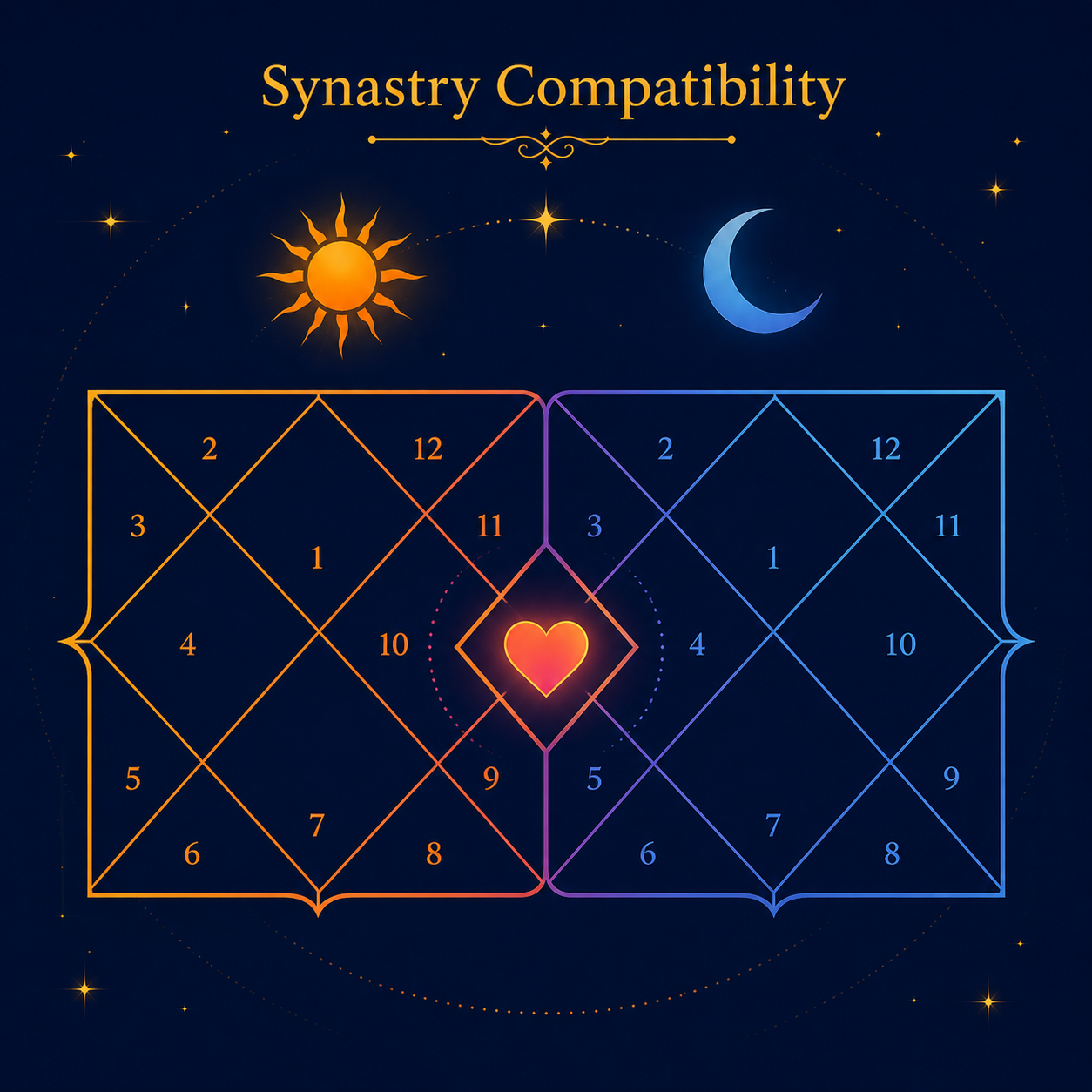
What is Synastry Compatibility?
When people search for synastry compatibility, they are usually looking for answers about love, attraction, emotional connection, and long-term relationship potential.
In Western astrology, synastry chart analysis compares two birth charts to reveal how two people influence each other.
It looks at planet-to-planet aspects, house placements, and key relationship indicators such as Venus, Moon, Mars, Saturn, and Mercury.
How Does Synastry Work?
A synastry chart can show why two people feel instantly comfortable together, why communication flows easily, or why the relationship may bring repeated tension.
For example, harmonious Venus and Moon connections often indicate affection and emotional support, while challenging Saturn aspects may point to lessons, delays, or commitment issues.
This is why relationship astrology has become such a popular way to explore compatibility before or during a relationship.
The Western Astrology Approach
Western astrology approaches compatibility as a dynamic interaction between two unique charts.
It does not simply ask whether two sun signs match.
Instead, it studies the full chart overlay to understand attraction, emotional needs, communication style, values, and long-term stability.
That deeper layer is what makes synastry chart reading so useful for anyone trying to understand a relationship more clearly.
Kundali Milan in Vedic Astrology
In Vedic astrology, a similar idea is known as Kundali Milan.
This traditional compatibility method compares the birth charts of two individuals to assess marriage potential, emotional harmony, family alignment, and long-term suitability.
While Western astrology often emphasizes psychological dynamics, Kundali Milan focuses more on doshas, guna matching, planetary strength, and relationship longevity.
Why Kundali Milan Matters
Kundali Milan is especially important in many Indian families because it provides a structured way to evaluate marriage compatibility.
The process often considers factors such as Guna Milan, Manglik dosha, Nadi dosha, and the overall balance between the two horoscopes.
These factors help identify whether the relationship may support mutual growth, stability, and shared family life.
Western Synastry vs Vedic Kundali Milan
Although Western astrology and Vedic astrology use different systems, both aim to answer the same core question: how well do two people fit together?
Synastry compatibility helps people understand relationship chemistry and emotional patterns, while Kundali Milan offers a more traditional marriage-oriented compatibility assessment.
Together, they give a fuller picture of relationship astrology from both modern and classical perspectives.
Get Your Free Kundali Matching
Ready to explore your relationship compatibility?
Get your free Kundali Milan report in seconds and discover your marriage matching score, dosha analysis, and compatibility insights.
Free Kundali Matching Now
No sign-up required. Instant results based on traditional Vedic astrology.
Free Kundali Matching Now
No sign-up required. Instant results based on traditional Vedic astrology.