

Adhik Mas — The Sacred Leap Month
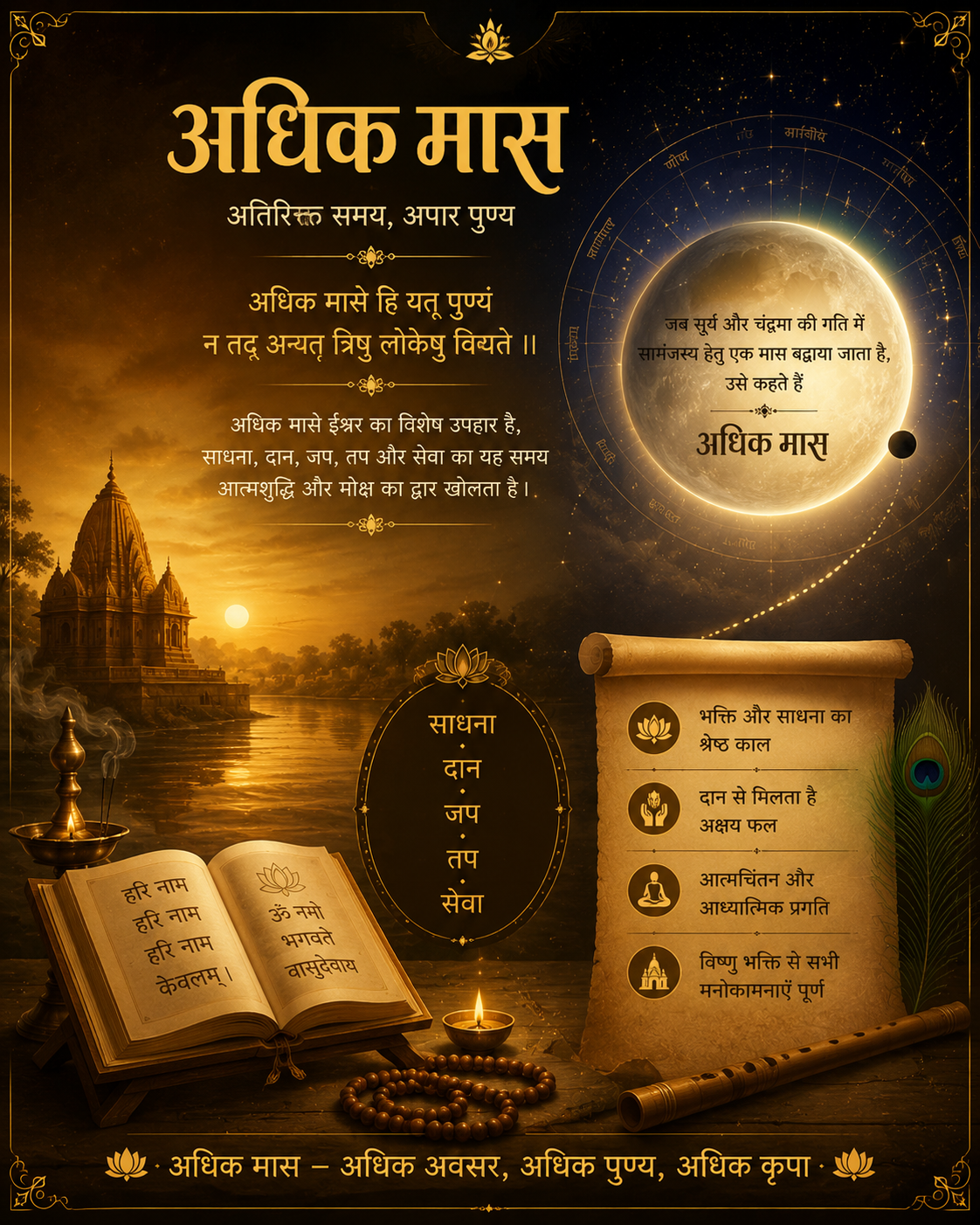
Adhika Māsa | Purushottam Mas | Mala Mas
What Is Adhik Mas and Why Does It Occur?
The Hindu calendar is lunisolar — it simultaneously tracks the Moon's monthly cycles and the Sun's annual journey through the twelve zodiac signs. A purely lunar year consists of 12 lunar months totalling roughly 354 days, while a solar year spans approximately 365.25 days. This leaves an annual shortfall of about 11 days.
Over roughly 32.5 months, this accumulated gap equals the length of one full lunar month. To prevent seasonal festivals (like Diwali, Holi, and harvests) from drifting away from their intended seasons, the Vedic calendar inserts an extra month — the Adhik Mas (adhik = surplus/extra; mas = month).
How Is Adhik Mas Determined in Vedic Astrology?
In Vedic astronomy, each normal lunar month contains at least one Sankranti — the moment the Sun crosses from one zodiac sign (Rashi) into the next. There are 12 Sankrantis in a solar year, one for each sign.
Because a lunar month (~29.5 days) is shorter than the Sun's average transit through one sign (~30.4 days), occasionally a lunar month passes entirely without any Sankranti. That month is declared Adhik Mas — the leap month. It borrows the name of the lunar month that immediately follows it. For example, if an extra month falls before the month of Kartik, it is called Adhik Kartik Mas.
| Aspect | Detail |
|---|---|
| Frequency | Once every ~32.5 months (approx. every 2.5–3 years) |
| Trigger | A lunar month with no solar Sankranti |
| Naming | Takes the name of the following month (e.g., Adhik Shravan) |
| Ruling Deity | Lord Vishnu (Purushottam) |
| Also Called | Purushottam Mas, Mala Mas, Adhika Māsa |
| Calendar System | Hindu Lunisolar (Panchanga) |
Detachment from the Solar Cycle — Its Unique Character
Because it doesn't have a solar transition (Sankranti), it was traditionally considered detached from the material solar cycle, earning it a few unique cultural traits:
No Material Celebrations (Kamya Karma)
Highly auspicious material milestones — like weddings, buying a house, starting a new business, or thread ceremonies — are generally paused during this month.
Amplified Spiritual Practices (Nishkama Karma)
Because it is detached from material alignment, it is considered highly sacred for selfless spiritual growth. Fasting, meditation, charity, and reciting scriptures (like the Bhagavata Purana) during this time are believed to carry amplified benefits.
What to Do During Adhik Mas
The spiritual merit (punya) earned during Adhik Mas is traditionally held to be many times greater than during an ordinary month. The following practices are highly recommended:
- Daily Bhagavata Parana Path — Reading or listening to the Shrimad Bhagavata Purana, especially the stories of Vishnu's avatars, is considered the foremost act of this month.
- Vishnu Sahasranama — Chanting the thousand names of Lord Vishnu daily.
- Ekadashi Fasts — Observing both Ekadashis (the 11th lunar day of each fortnight) that fall within the month carries exceptional merit.
- Satyanarayan Katha — Performing or attending this Vaishnava puja is considered especially fruitful during Adhik Mas.
- Daily Deepa (Lamp) Offering — Lighting a ghee lamp before the Tulsi plant or Vishnu idol every evening throughout the month.
- Chanting the Mahamantra — Reciting Hare Krishna Hare Krishna, Krishna Krishna Hare Hare / Hare Rama Hare Rama, Rama Rama Hare Hare.
- Bathing in Sacred Rivers — A dip in the Ganga, Yamuna, Godavari, or other sacred rivers (or offering symbolic Ganga Jal) is meritorious.
- Tulsi Puja — Daily worship of the Tulsi (holy basil) plant is particularly auspicious throughout this month.
- Anna Daan (Food Donation) — Feeding Brahmins, priests, and the needy is considered one of the highest acts of charity during Adhik Mas.
What to Avoid During Adhik Mas
The month is considered inauspicious for Kamya Karma — actions motivated by material desire. The following ceremonies are traditionally deferred:
Emergency life events (urgent medical needs, unavoidable travel, etc.) are naturally exempt from these traditional guidelines.
Traditional Customs & Cultural Practices
Beyond individual spiritual practice, Adhik Mas is marked by a rich tapestry of community and family traditions across India:
Son-in-Law Gifting (Jamai Sashti / Damad Tradition)
One of the most widely observed customs is for the bride's parents (sasural) to invite their daughter and son-in-law (jamai / damad) to their home and gift them with new clothes, sweets, dry fruits, utensils, and household items. This gesture is seen as an expression of love, gratitude, and blessings — and doing it during Adhik Mas is believed to multiply the spiritual merit of the act.
Vastra Daan (Clothing Donation)
Donating new clothes to Brahmins, priests, and the underprivileged is a major act of daan (charity) specifically associated with this month. Families visit temples and distribute cloth, believing that the recipient's blessings carry amplified weight during Adhik Mas.
Anna Daan & Community Feasting
Organising or contributing to community meals (bhandara) at temples is considered deeply meritorious. Many families sponsor meals for hundreds of devotees on auspicious days within the month, especially on Ekadashi.
Bhagavata Saptah (Seven-Day Recitation)
Communities and temples organise week-long recitations of the entire Bhagavata Purana (Bhagavata Saptah). Attending even a few sessions is considered highly auspicious, and completing the entire seven-day listening brings the merit of many pilgrimages.
Ganga Snan & Tirtha Yatra (Pilgrimage)
Visiting sacred pilgrimage sites — Mathura, Vrindavan, Haridwar, Kashi, Prayagraj — during Adhik Mas is believed to grant merit equivalent to performing those pilgrimages many times over. Daily bathing in a sacred river or offering Ganga Jal at home is widely practised.
Deepa Mahotsava (Lamp Festival)
In many regions, devotees light 33 ghee lamps in front of the Vishnu idol or Tulsi plant every evening throughout the month, accompanied by Vishnu Sahasranama chanting. This is called Deepa Daan and is seen as one of the simplest yet most powerful practices of the month.
Tulsi Vivah Preparation
In some traditions, Adhik Mas preceding Kartik is used for intensified Tulsi worship and preparations for Tulsi Vivah (the ceremonial wedding of Tulsi with Lord Vishnu, observed on Kartik Shukla Ekadashi or Dwadashi). The extra month provides additional time for devotion and preparation.
Astrological Impact of Adhik Mas
Planets continue their transits as normal during Adhik Mas — their movement through the zodiac is purely astronomical and unaffected by the calendar designation. The primary domain where Adhik Mas carries astrological weight is Muhurta Shastra (electional astrology — the science of choosing auspicious timings for events):
- Muhurtas for worldly ceremonies are suspended. Even if a normally auspicious Nakshatra–Tithi–Vara combination falls during Adhik Mas, it is generally not used for major life-event ceremonies.
- Spiritual Muhurtas are enhanced. Times like Brahma Muhurta, Ekadashi, Purnima, and Amavasya that fall within Adhik Mas are treated as especially potent for prayer, fasting, and meditation.
- No new Dasha or transit effects. Planetary Dashas (periods), Antardashas, and transit effects calculated in a birth chart are not altered by Adhik Mas — they run continuously as per sidereal planetary motion.
People Also Ask
Explore more Astrology articles