

Gandanta in Vedic Astrology: The Karmic Knot Between Water and Fire
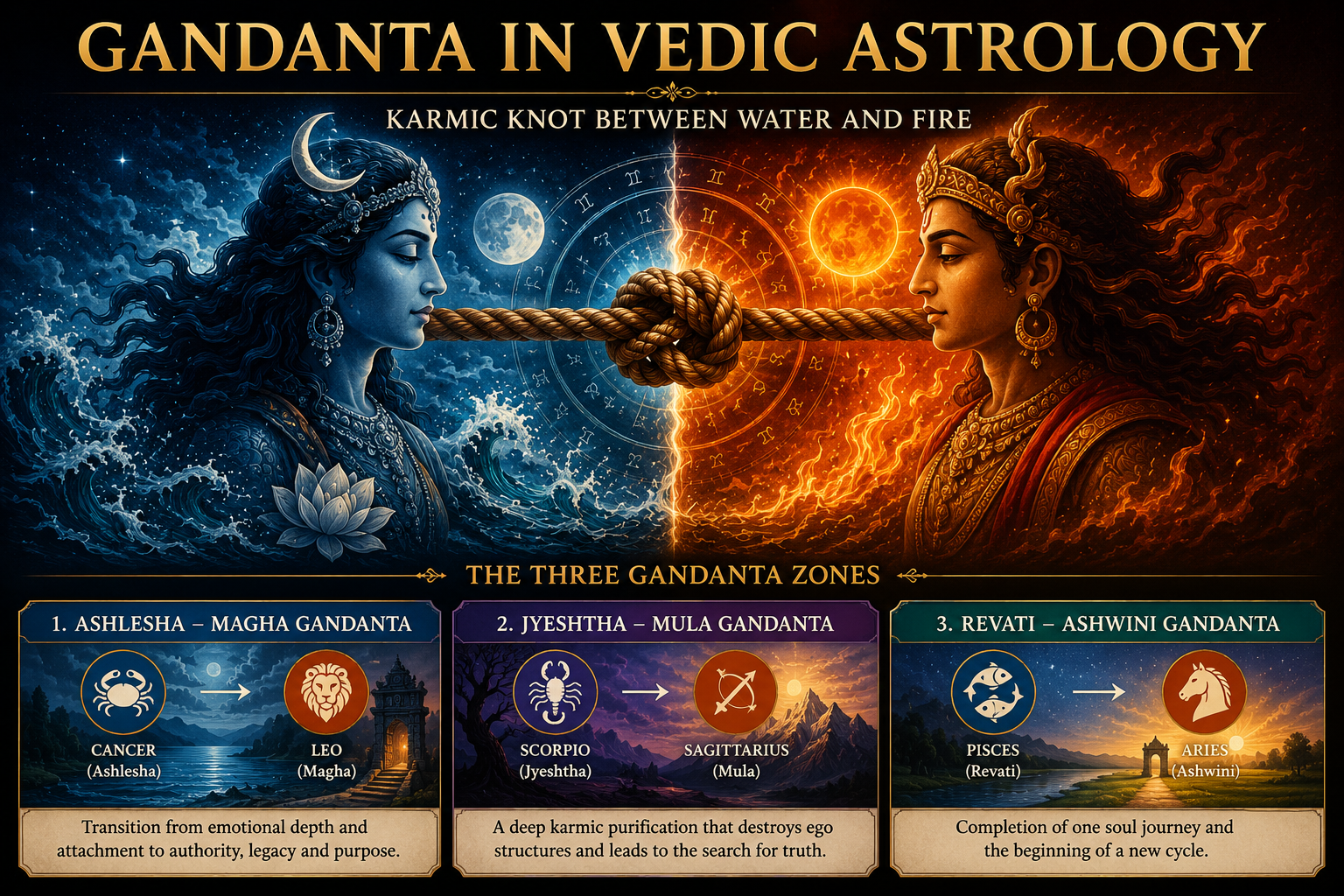
Among the many fascinating concepts in Vedic astrology, few inspire as much curiosity—and misunderstanding—as Gandanta. Often described as a "karmic knot" or a point of crisis, Gandanta represents a transition zone where the soul moves between two fundamentally different energies. While traditional texts associate Gandanta with challenges, modern astrologers increasingly view it as a powerful indicator of spiritual growth and transformation.
So, what exactly is Gandanta, and what does it mean if you have planets placed there?
So, what exactly is Gandanta, and what does it mean if you have planets placed there?
What Does Gandanta Mean?
The word Gandanta comes from two Sanskrit words:
In Vedic astrology, Gandanta occurs at the junction between water signs and fire signs. These transitions are considered sensitive because water and fire represent opposing elements. Water symbolizes emotions, attachment, and dissolution, while fire represents action, transformation, and rebirth.
The soul must release one state of consciousness before entering another, creating a point of tension and growth.
- Granthi (Ganda) – knot
- Anta – end
In Vedic astrology, Gandanta occurs at the junction between water signs and fire signs. These transitions are considered sensitive because water and fire represent opposing elements. Water symbolizes emotions, attachment, and dissolution, while fire represents action, transformation, and rebirth.
The soul must release one state of consciousness before entering another, creating a point of tension and growth.
The Three Gandanta Zones
There are three Gandanta regions in the zodiac:
Traditionally, the last 48 minutes (approximately 0°48') of the water sign and the first 48 minutes of the fire sign are considered Gandanta. These zones occur at the transitions between the following nakshatras:
| Water Sign | Fire Sign | Gandanta Zone |
|---|---|---|
| Cancer | Leo | Ashlesha → Magha |
| Scorpio | Sagittarius | Jyeshtha → Mula |
| Pisces | Aries | Revati → Ashwini |
Traditionally, the last 48 minutes (approximately 0°48') of the water sign and the first 48 minutes of the fire sign are considered Gandanta. These zones occur at the transitions between the following nakshatras:
-
1. Ashlesha–Magha Gandanta
End of Ashlesha (Cancer) → Beginning of Magha (Leo). This transition involves moving from emotional entanglement and psychological complexity toward personal authority, leadership, and ancestral responsibility. -
2. Jyeshtha–Mula Gandanta
End of Jyeshtha (Scorpio) → Beginning of Mula (Sagittarius). Often considered the most intense Gandanta, this zone relates to destruction of ego structures, deep karmic purification, and the search for ultimate truth. -
3. Revati–Ashwini Gandanta
End of Revati (Pisces) → Beginning of Ashwini (Aries). This transition symbolizes the completion of one soul journey and the beginning of another. It is often associated with healing, renewal, and spiritual rebirth.
Why Is Gandanta Considered Significant?
Water signs represent emotional attachments, memories, and accumulated karmic impressions. Fire signs represent action, purpose, and evolution. At Gandanta, the soul stands at a threshold:
- What must be released?
- What must be transformed?
- What new direction must emerge?
Gandanta and the Moon
The Moon is the most commonly discussed Gandanta placement. A person born with the Moon in Gandanta may experience:
- Emotional intensity
- Feelings of being misunderstood
- Early-life instability or transitions
- Deep sensitivity to family karma
- Strong spiritual potential
Gandanta and Other Planets
The specific evolutionary lessons vary depending on the planet tangled within the knot:
- Sun in Gandanta: The individual may struggle with identity, confidence, or authority before developing strong self-awareness and leadership abilities.
- Moon in Gandanta: Emotional patterns and family attachments become major areas of growth.
- Mars in Gandanta: Lessons involve anger, courage, conflict, and the constructive use of personal power.
- Mercury in Gandanta: Communication, learning, and decision-making may require repeated refinement.
- Jupiter in Gandanta: The person may question beliefs, teachers, or religious traditions before developing genuine wisdom.
- Venus in Gandanta: Relationships become important catalysts for transformation and spiritual growth.
- Saturn in Gandanta: Life may present responsibilities and delays that ultimately cultivate maturity, endurance, and detachment.
- Rahu and Ketu in Gandanta: These placements often indicate strong karmic themes and significant evolutionary lessons.
Gandanta Is Not a Curse
One of the greatest misconceptions about Gandanta is that it automatically produces suffering or misfortune. This is not supported by real-world observation.
Many highly successful, influential, and spiritually evolved individuals have Gandanta placements. What distinguishes them is not the absence of challenges but their ability to transform those challenges into wisdom.
A Gandanta planet often indicates:
Many highly successful, influential, and spiritually evolved individuals have Gandanta placements. What distinguishes them is not the absence of challenges but their ability to transform those challenges into wisdom.
A Gandanta planet often indicates:
- An unfinished karmic lesson
- A powerful evolutionary task
- A doorway to spiritual growth
Traditional Remedies for Gandanta
Classical astrologers often recommend spiritual practices to help untie the karmic knot associated with Gandanta. Some commonly suggested remedies include:
- Regular meditation
- Mantra recitation
- Charity and selfless service
- Worship of the ruling deity of the Gandanta nakshatra
- Honoring ancestors
- Pilgrimage and spiritual study
Final Thoughts
Gandanta represents one of the most profound concepts in Vedic astrology. It is not merely a difficult placement but a symbol of transition, transformation, and spiritual evolution.
Where ordinary planetary placements describe talents and tendencies, Gandanta points to areas where the soul is actively untangling old karmic patterns and preparing for a new level of growth.
Rather than fearing Gandanta, it may be more accurate to view it as a sacred threshold—a place where endings and beginnings meet, and where some of life's deepest lessons are learned.
Where ordinary planetary placements describe talents and tendencies, Gandanta points to areas where the soul is actively untangling old karmic patterns and preparing for a new level of growth.
Rather than fearing Gandanta, it may be more accurate to view it as a sacred threshold—a place where endings and beginnings meet, and where some of life's deepest lessons are learned.
Explore more Astrology articles