

Vedic Astrology vs Western Astrology: Unveiling the Two Paths
The Question of Two Stars
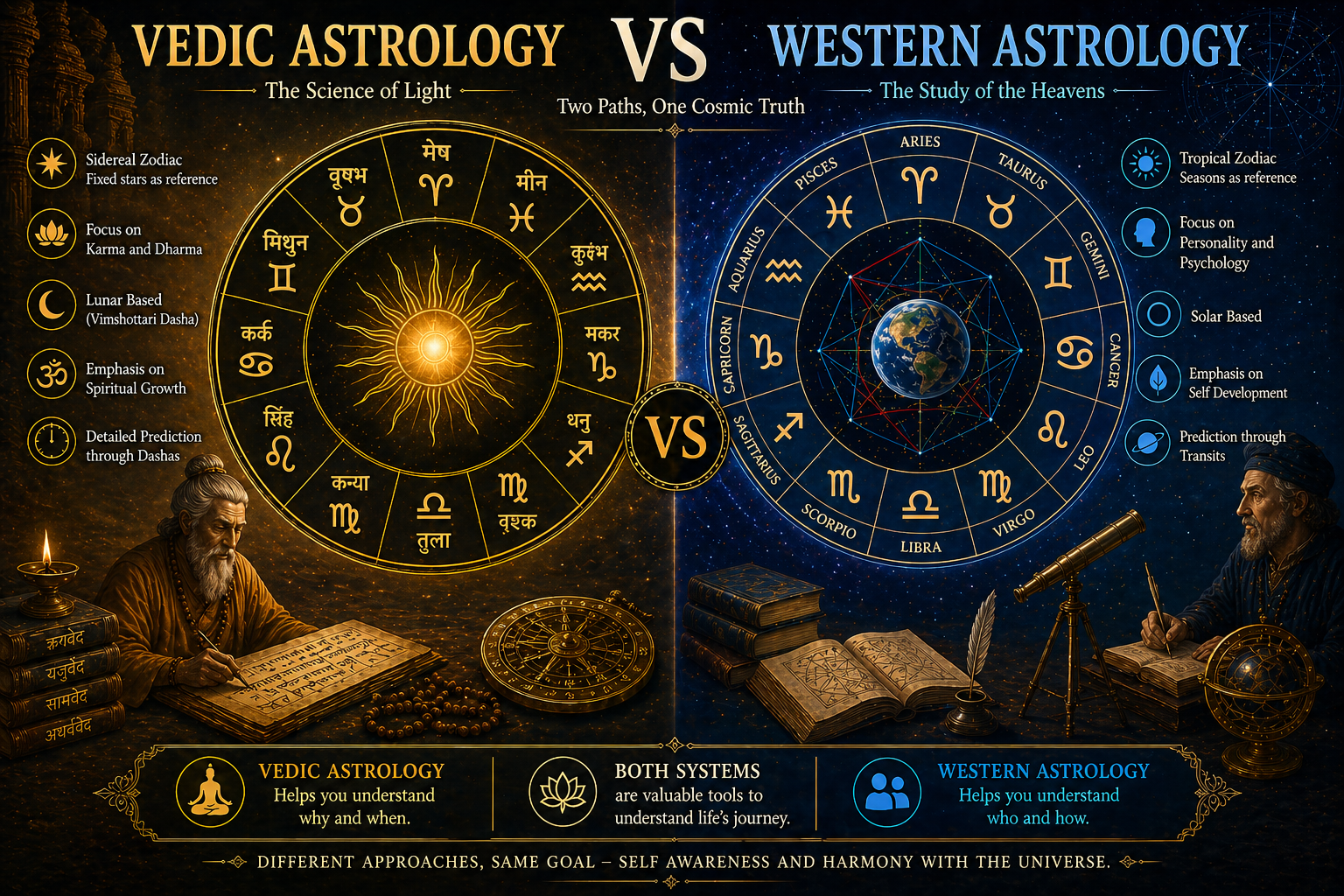
When people first encounter astrology, they often assume it is a single, unified system. However, the world of astrological wisdom is divided into two primary traditions: Vedic Astrology (Jyotish), originating in ancient India, and Western Astrology, which developed in the Hellenistic world and modern Europe.
If you've ever looked up your horoscope in a Western magazine and then had a Vedic reading, you might have been shocked to discover your Sun sign had changed! This is the most famous difference, but the distinctions go much deeper, reflecting fundamentally different philosophical, technical, and spiritual approaches to interpreting the heavens.
If you've ever looked up your horoscope in a Western magazine and then had a Vedic reading, you might have been shocked to discover your Sun sign had changed! This is the most famous difference, but the distinctions go much deeper, reflecting fundamentally different philosophical, technical, and spiritual approaches to interpreting the heavens.
Technological Clash: Sidereal vs. Tropical Zodiac
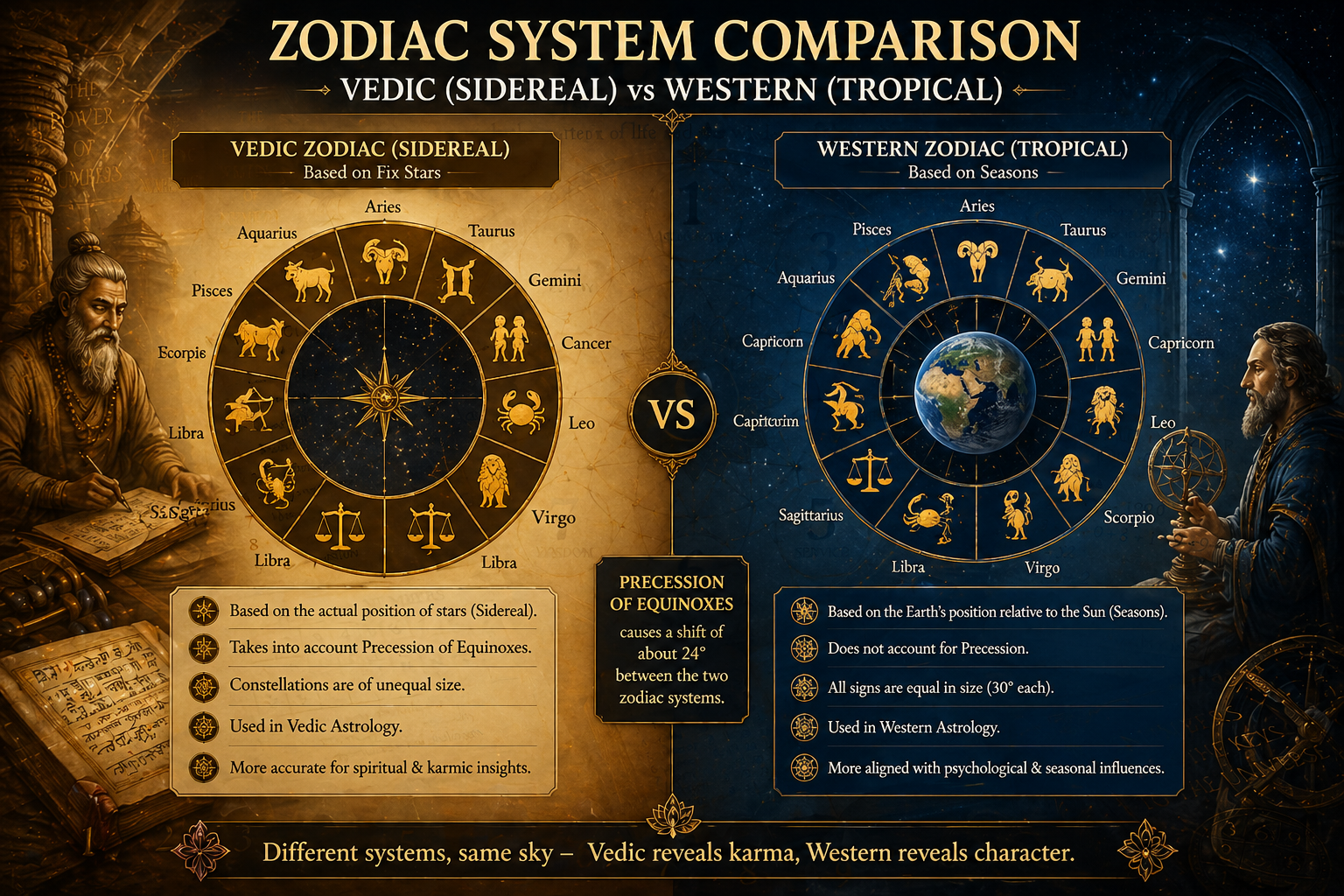
The core difference that splits the two systems is the Zodiac they employ.
- Western Astrology uses the Tropical Zodiac. This system is fixed to the Earth's seasons. The point of the Spring Equinox (around March 21st) is always defined as 0 degrees Aries. It measures the Sun's relationship to the Earth's tilt, focusing on the *psychological environment* of the native.
- Vedic Astrology uses the Sidereal Zodiac. This system is fixed to the *actual constellations* visible in the sky. It measures where the planets are physically located against the backdrop of the stars. It focuses on the *soul's karmic reality*.
The Philosophical Lens: Personality vs. Karma
The fundamental difference in *approach* defines what each system does best:
Western Astrology is primarily Psychological. It excels at character analysis, understanding personality dynamics, identifying personal strengths, and illuminating the native's psychological landscape. It asks: *How does this person perceive the world, and how can they integrate their personality?*
Vedic Astrology is primarily Karmic. It is built upon the doctrines of reincarnation and **Karma** (cause and effect). Your birth chart is seen as a visual map of the soul’s previous actions and its current spiritual trajectory. It asks: *Why did this soul incarnate now, what karmic debts must it pay, and what is its fundamental Dharma (duty)?*
Western Astrology is primarily Psychological. It excels at character analysis, understanding personality dynamics, identifying personal strengths, and illuminating the native's psychological landscape. It asks: *How does this person perceive the world, and how can they integrate their personality?*
Vedic Astrology is primarily Karmic. It is built upon the doctrines of reincarnation and **Karma** (cause and effect). Your birth chart is seen as a visual map of the soul’s previous actions and its current spiritual trajectory. It asks: *Why did this soul incarnate now, what karmic debts must it pay, and what is its fundamental Dharma (duty)?*
Key Components: Where the Systems Diverge
Beyond the zodiac, the two paths utilize different predictive tools and technical markers:
- The Emphasis: Sun vs. Moon. Western astrology focuses heavily on the **Sun Sign** as the core identity. Vedic astrology views the Sun as the soul, but places paramount importance on the **Moon Sign** (Rashi) and the **Ascendant** (Lagna) as the main indicators of personality, mind, and the physical reality of life.
- The Hidden Stars: Nakshatras. This is unique to Vedic astrology. Beyond the 12 signs, Jyotish uses a deeper system of 27 Nakshatras (Lunar Mansions). This hyper-detailed system provides precise, chart-specific significations for temperament, timing, and compatibility that are unavailable in Western astrology.
- Planetary Timing: Dashas. This is the *killer application* of Vedic astrology. While Western astrology relies heavily on transits (where the planets are *now*) and progressions, Vedic astrology calculates a precise predictive timeline called the Vimshottari Dasha system. It tells you *which planet* is currently activating your chart, explaining why certain years are defined by career, others by family, etc.
- Planetary Significators: Karakas. Western astrology uses fixed karakas (Venus always rules love). Vedic astrology also uses fixed significators, but uniquely adds dynamic, chart-specific ones like the Chara Karakas, identifying specific planets as the **Atmakaraka** (Soul planet) or **Darakaraka** (Spouse planet) *for that specific chart*.
Summary: Two Roads, One Destiny?
So, is one better than the other? Not necessarily. They are better understood as two lenses—each revealing a different layer of the same cosmic reality.
In the end, both systems point to the same truth: your life is not random. It is patterned, meaningful, and deeply connected to the cosmos. The real power lies not in which system you follow—but in how consciously you use it.
- If your goal is introspection—understanding your personality, emotional patterns, and inner conflicts—Western Astrology offers a rich psychological framework. It helps you explore who you are.
- If your focus is direction—uncovering life purpose, karmic patterns, and the timing of key events—Vedic Astrology (Jyotish) provides a precise and time-tested roadmap. It helps you understand why things unfold the way they do.
In the end, both systems point to the same truth: your life is not random. It is patterned, meaningful, and deeply connected to the cosmos. The real power lies not in which system you follow—but in how consciously you use it.
Explore more Astrology articles