
What is My Astrological Sign? Sun Sign, Rashi, and the Vedic Difference
Two Traditions, One Question
When someone asks "what is my astrological sign?", they are usually thinking of the Western tradition — the Sun sign printed in newspaper horoscopes. But astrology is not one system. Two rich and independent traditions answer this question differently, and understanding both gives you a far more complete picture of yourself.
In Western astrology, your sign is your Sun sign — determined by where the Sun was on your birthday. In Vedic astrology (Jyotish), the equivalent is your Rashi (राशि) — but here, it is most commonly your Moon sign that carries the greatest weight, not your Sun sign. The two systems also use different zodiacs, which means your sign can differ between the two traditions. Both are explored below.
In Western astrology, your sign is your Sun sign — determined by where the Sun was on your birthday. In Vedic astrology (Jyotish), the equivalent is your Rashi (राशि) — but here, it is most commonly your Moon sign that carries the greatest weight, not your Sun sign. The two systems also use different zodiacs, which means your sign can differ between the two traditions. Both are explored below.
Western Astrology: Your Sun Sign
In the Western tradition, your Sun sign is the zodiac sign the Sun occupied on the day you were born. The Sun moves through all 12 signs over the course of a year, spending roughly 30 days in each. Your birthday alone is sufficient to identify it.
The Western system uses the tropical zodiac, anchored to the Earth's seasons — Aries begins at the Spring Equinox, regardless of where the actual constellation of Aries sits in the sky. Use the date ranges below to find your Western Sun sign:
The Western system uses the tropical zodiac, anchored to the Earth's seasons — Aries begins at the Spring Equinox, regardless of where the actual constellation of Aries sits in the sky. Use the date ranges below to find your Western Sun sign:
Aries ♈
March 21 – April 19
Taurus ♉
April 20 – May 20
Gemini ♊
May 21 – June 20
Cancer ♋
June 21 – July 22
Leo ♌
July 23 – August 22
Virgo ♍
August 23 – September 22
Libra ♎
September 23 – October 22
Scorpio ♏
October 23 – November 21
Sagittarius ♐
November 22 – December 21
Capricorn ♑
December 22 – January 19
Aquarius ♒
January 20 – February 18
Pisces ♓
February 19 – March 20
Vedic Astrology: Your Rashi
Vedic astrology (Jyotish) also uses 12 signs, called Rashis, with the same names and ruling planets as the Western signs — Mesha (Aries), Vrishabha (Taurus), Mithuna (Gemini), and so on through Meena (Pisces). However, two fundamental differences set the Vedic approach apart.
1. The Sidereal Zodiac: Jyotish uses the sidereal zodiac, anchored to the actual, observable positions of the fixed stars in the sky — not the seasons. Due to the slow wobble of the Earth's axis (the precession of the equinoxes), the tropical and sidereal zodiacs are currently about 23–24 degrees apart. In practical terms, this means your Vedic Sun sign (Surya Rashi) is typically one sign behind your Western Sun sign. A person who is a Western Scorpio may be a Vedic Tula (Libra).
2. The Moon Sign Comes First: In Jyotish, it is the Chandra Rashi (Moon sign) — not the Sun sign — that is considered the primary identifier of a person. When a Vedic astrologer asks "what is your Rashi?", they almost always mean your Moon sign. This is because the Moon, which changes sign every 2.5 days, captures the subtle emotional temperament, karmic memory, and inner psychological landscape of the individual with far greater precision than the Sun, which remains in one sign for a full month.
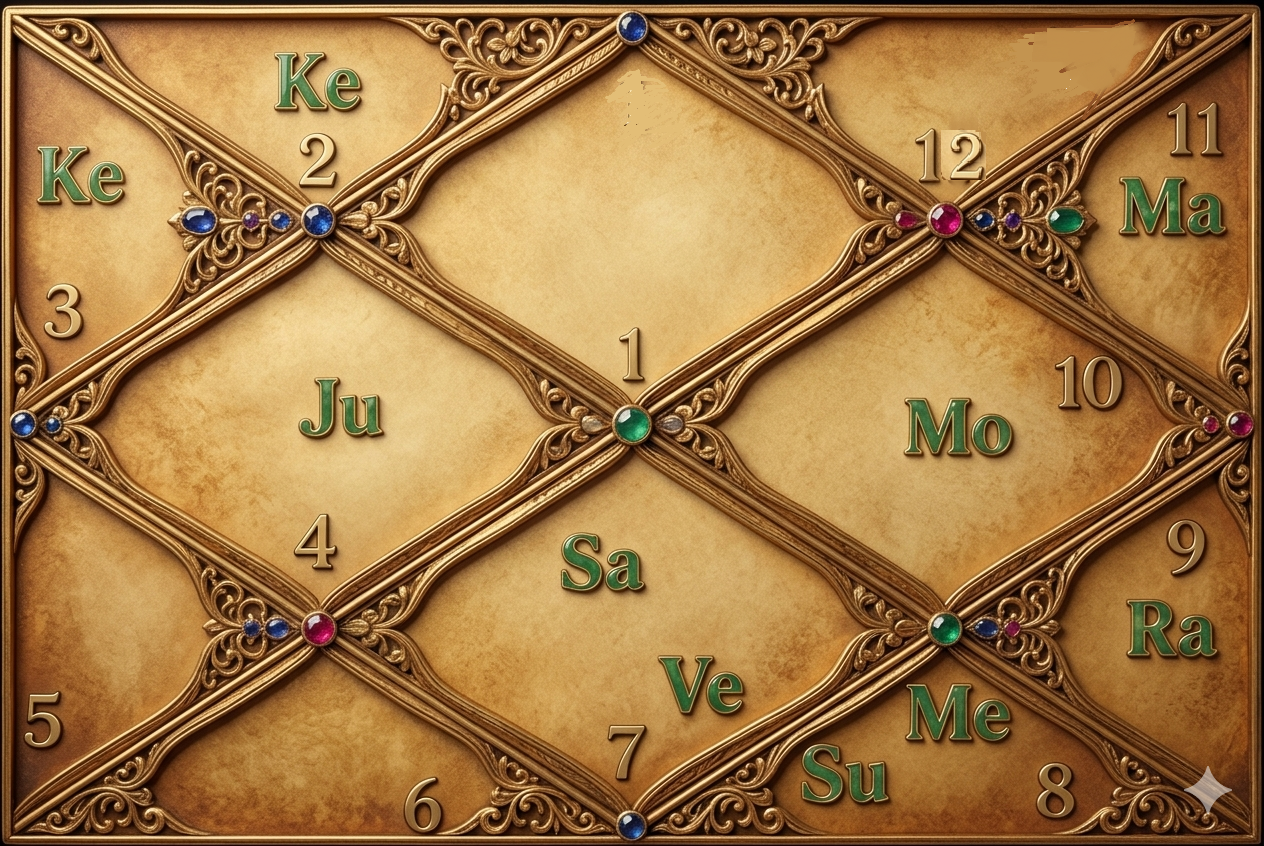
To know your Chandra Rashi Lagna and Sun Rashi, you need your birth date, accurate birth time, and place of birth. Based on this, you can generate your birth chart using our Birth Chart Calculator.
Refer below a sample birth chart.
1. The Sidereal Zodiac: Jyotish uses the sidereal zodiac, anchored to the actual, observable positions of the fixed stars in the sky — not the seasons. Due to the slow wobble of the Earth's axis (the precession of the equinoxes), the tropical and sidereal zodiacs are currently about 23–24 degrees apart. In practical terms, this means your Vedic Sun sign (Surya Rashi) is typically one sign behind your Western Sun sign. A person who is a Western Scorpio may be a Vedic Tula (Libra).
2. The Moon Sign Comes First: In Jyotish, it is the Chandra Rashi (Moon sign) — not the Sun sign — that is considered the primary identifier of a person. When a Vedic astrologer asks "what is your Rashi?", they almost always mean your Moon sign. This is because the Moon, which changes sign every 2.5 days, captures the subtle emotional temperament, karmic memory, and inner psychological landscape of the individual with far greater precision than the Sun, which remains in one sign for a full month.
To know your Chandra Rashi Lagna and Sun Rashi, you need your birth date, accurate birth time, and place of birth. Based on this, you can generate your birth chart using our Birth Chart Calculator.
Refer below a sample birth chart.
The Four Elements
Both traditions group the 12 signs into four classical elements, describing fundamental temperaments. These are shared across Western and Vedic astrology, though Jyotish adds further nuance through the Nakshatras and divisional charts layered on top.
- Fire — Agni (Aries, Leo, Sagittarius): Passionate, energetic, bold, and action-oriented. Fire signs lead with enthusiasm and inspiration.
- Earth — Prithvi (Taurus, Virgo, Capricorn): Practical, grounded, reliable, and patient. Earth signs build lasting structures in the material world.
- Air — Vayu (Gemini, Libra, Aquarius): Intellectual, social, communicative, and idea-driven. Air signs thrive on connection and exchange.
- Water — Jala (Cancer, Scorpio, Pisces): Intuitive, emotional, empathetic, and deeply feeling. Water signs navigate life through instinct and depth.
Which Sign Should I Use?
Both are valid within their own systems, and neither cancels the other out. If you are reading a Western horoscope, use your Western Sun sign. If you are consulting a Vedic astrologer or exploring Jyotish, your Chandra Rashi (Moon sign in the sidereal zodiac) is the more relevant starting point.
For a truly personal reading in either tradition, the Sun sign or Rashi alone is never sufficient. Your Rising sign (Ascendant or Lagna), Moon sign, and the full planetary picture at the moment of your birth together form the complete astrological portrait. The Sun sign is simply the door — the real depth lies inside.
For a truly personal reading in either tradition, the Sun sign or Rashi alone is never sufficient. Your Rising sign (Ascendant or Lagna), Moon sign, and the full planetary picture at the moment of your birth together form the complete astrological portrait. The Sun sign is simply the door — the real depth lies inside.
Summary
"What is my astrological sign?" has two equally valid answers depending on which tradition you are exploring. In Western astrology, it is your Sun sign — found by your birthday in the tropical zodiac. In Vedic astrology, the more meaningful identifier is your Chandra Rashi — your Moon sign in the sidereal zodiac, which requires your exact birth time and place to determine. If you have only ever known your Western Sun sign, discovering your Vedic Rashi is often the first step into a far richer and more personally resonant astrological world.
Explore more Astrology articles