

Nag Panchami 2026: Stories, Significance & Puja
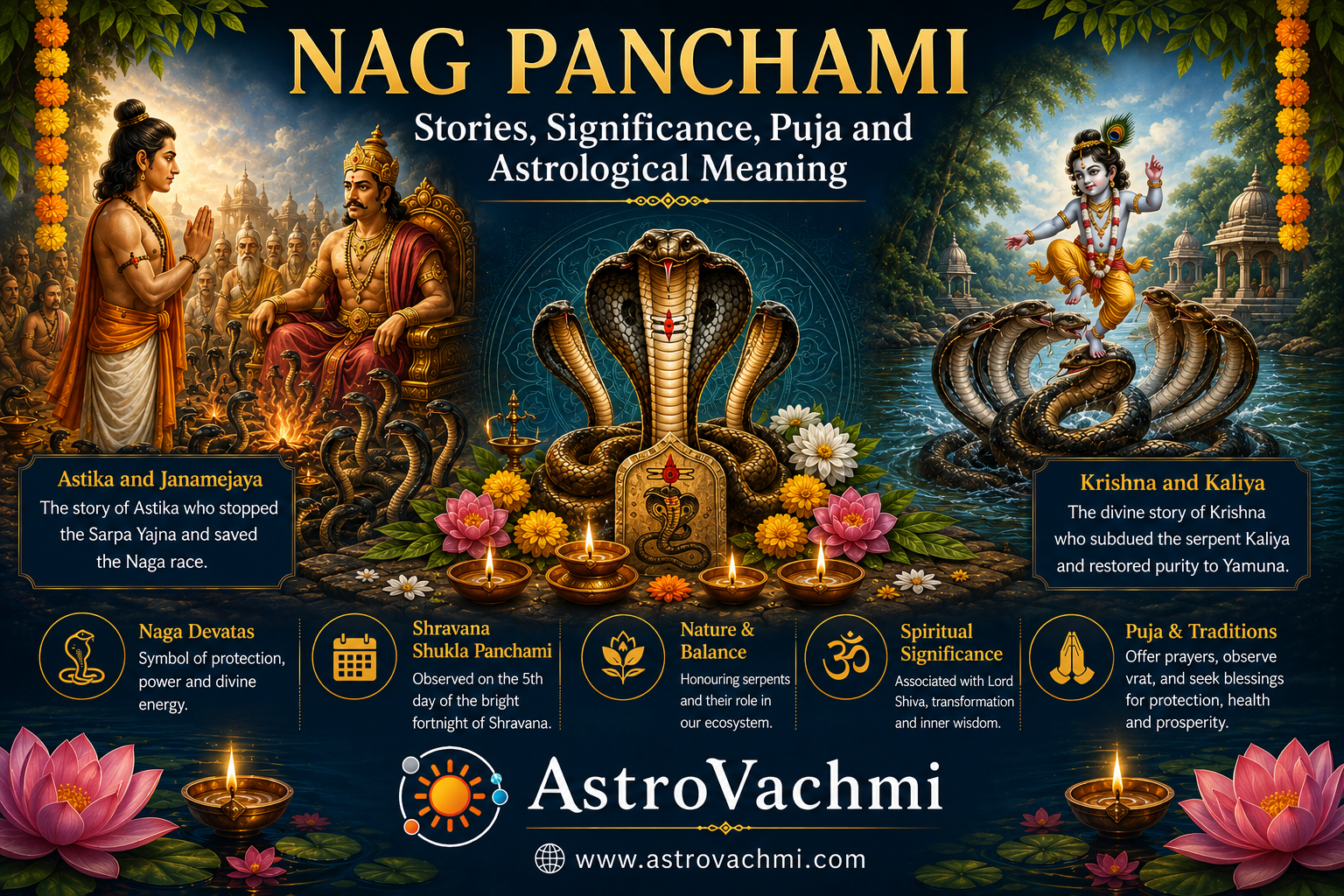
What is Nag Panchami?
Nag Panchami, also known as Naga Panchami, is one of the most fascinating festivals of the Hindu calendar, dedicated to the worship of Naga Devatas, or sacred serpent deities. It is observed on Shravana Shukla Panchami, the fifth day of the bright fortnight of the month of Shravana, though regional calendars can differ slightly in their observance.
The festival brings together several layers of tradition - worship of Naga Devatas, respect for nature and living creatures, protection and family wellbeing, agricultural symbolism, and stories from the Mahabharata and Puranic traditions.
The festival brings together several layers of tradition - worship of Naga Devatas, respect for nature and living creatures, protection and family wellbeing, agricultural symbolism, and stories from the Mahabharata and Puranic traditions.
Nag Panchami 2026: Date and Tithi
Nag Panchami 2026 falls on Monday, August 17, 2026.
According to the AstroVachmi Panchanga calculation:
Since Panchami Tithi is present at sunrise on August 17, Nag Panchami is observed on that day under this calculation. The exact Puja Muhurat can still vary by location, since Hindu festivals are determined using local sunrise, Tithi and Panchanga conditions - check the Panchami Dates 2026 page for location-specific timings.
According to the AstroVachmi Panchanga calculation:
| Tithi | Begins | Ends |
|---|---|---|
| Shravana Shukla Panchami | Aug 16, 2026 - 4:53 PM IST | Aug 17, 2026 - 5:00 PM IST |
Why is Nag Panchami Celebrated?
No single story explains every regional tradition surrounding Nag Panchami. Instead, several important threads have become associated with the festival - most notably the story of Astika and King Janamejaya's Sarpa Yajna from the Mahabharata, and the story of Krishna and Kaliya, the serpent of the Yamuna. Together, these stories show that the serpent is not merely an object of fear - the Naga represents power, danger, protection, hidden forces, transformation, and the balance between humans and nature.
The Story of Astika and Janamejaya
The story begins with King Parikshit, grandson of Arjuna, who was bitten and killed by the serpent king Takshaka. When Parikshit's son, King Janamejaya, learned of his father's death, he was consumed by anger and vowed to destroy the entire serpent race. He undertook a great ritual known as the Sarpa Yajna, or snake sacrifice, drawing countless serpents toward the sacrificial fire - even Takshaka himself was nearly pulled in, despite having taken refuge with Indra.
At this critical moment, a wise young sage named Astika appeared. Born from the union of the Brahmin sage Jaratkaru and a woman of the Naga lineage, Astika belonged to both the human and serpent worlds, and the Nagas placed their hope in him. Through his wisdom and eloquence, he pleased King Janamejaya and was granted a boon - his simple request was to stop the sacrifice. Janamejaya agreed, and the destruction of the serpents came to an end.
The deeper lesson of this story gives Nag Panchami a philosophical dimension: Janamejaya's grief turned into anger, and anger threatened to destroy an entire species, until Astika's wisdom interrupted the cycle. Revenge, the story suggests, must eventually give way to wisdom, and destruction to balance.
At this critical moment, a wise young sage named Astika appeared. Born from the union of the Brahmin sage Jaratkaru and a woman of the Naga lineage, Astika belonged to both the human and serpent worlds, and the Nagas placed their hope in him. Through his wisdom and eloquence, he pleased King Janamejaya and was granted a boon - his simple request was to stop the sacrifice. Janamejaya agreed, and the destruction of the serpents came to an end.
The deeper lesson of this story gives Nag Panchami a philosophical dimension: Janamejaya's grief turned into anger, and anger threatened to destroy an entire species, until Astika's wisdom interrupted the cycle. Revenge, the story suggests, must eventually give way to wisdom, and destruction to balance.
Krishna and Kaliya: The Serpent of the Yamuna
Another beloved story connected with Nagas is that of Krishna and Kaliya. The serpent Kaliya had taken residence in the Yamuna, poisoning its waters and endangering those nearby. Young Krishna entered the river and confronted the powerful serpent, eventually subduing him by dancing upon his hoods. When Kaliya's wives pleaded for mercy, Krishna spared the serpent and instructed him to leave the Yamuna.
Read symbolically, this story is the triumph of divine consciousness over poisonous and destructive forces - the serpent is not destroyed, but subdued and transformed, a reminder that destructive power can sometimes be controlled rather than annihilated.
Read symbolically, this story is the triumph of divine consciousness over poisonous and destructive forces - the serpent is not destroyed, but subdued and transformed, a reminder that destructive power can sometimes be controlled rather than annihilated.
What Do Nagas Symbolize?
The serpent occupies a unique place in Hindu religious symbolism. A serpent rests around the neck of Lord Shiva; Vishnu reclines upon Ananta Shesha, the cosmic serpent; and Vasuki plays a central role in the churning of the ocean, while Takshaka and other Nagas appear throughout the Mahabharata and Puranas. This gives the serpent several layers of meaning:
- Protection: Nagas are widely regarded as guardians and protectors.
- Hidden knowledge: Living beneath the earth and appearing suddenly, serpents are linked with mysteries and hidden realms.
- Transformation: The shedding of a snake's skin makes it a natural symbol of renewal.
- Power: A serpent's latent danger makes it a symbol of power that must be respected.
- Water and fertility: Naga traditions are closely tied to water bodies, fertility, and the natural environment.
Why Panchami, and Why Shravana?
Nag Panchami is observed specifically on Panchami Tithi, the fifth lunar day of Shukla Paksha, since Panchami is itself considered an important tithi in the Hindu calendar. This is also why the festival is best understood through the Panchanga rather than as a fixed Gregorian date - the underlying lunar day and its relationship with sunrise determine the observance each year.
There is a practical seasonal dimension too. Shravana falls during India's monsoon, when heavy rains often force snakes out of their burrows and closer to human settlements. At the same time, snakes help protect crops by preying on rodents - so the festival can also be read as an expression of respect for the natural environment and the agricultural cycle.
Nag Panchami also has a natural connection with Lord Shiva, who is traditionally depicted wearing a serpent around his neck as a symbol of mastery over fear, death and powerful natural forces. Since the festival falls in Shravana - a month strongly associated with Shiva worship - many devotees combine Naga worship with prayers to Shiva.
There is a practical seasonal dimension too. Shravana falls during India's monsoon, when heavy rains often force snakes out of their burrows and closer to human settlements. At the same time, snakes help protect crops by preying on rodents - so the festival can also be read as an expression of respect for the natural environment and the agricultural cycle.
Nag Panchami also has a natural connection with Lord Shiva, who is traditionally depicted wearing a serpent around his neck as a symbol of mastery over fear, death and powerful natural forces. Since the festival falls in Shravana - a month strongly associated with Shiva worship - many devotees combine Naga worship with prayers to Shiva.
How is Nag Panchami Celebrated?
Nag Panchami traditions vary considerably across regions. In many places, devotees worship representations of Naga Devatas made of clay, silver, stone or wood, draw serpent images near the entrance of the home, visit Shiva or Naga temples, and observe a fast according to family custom. Common devotional practices include:
- Worshipping Naga Devatas
- Offering flowers and traditional puja items
- Drawing serpent images near the entrance of the home
- Visiting Shiva or Naga temples
- Reciting the Nag Panchami vrat katha
- Observing a fast according to family tradition
- Offering charity and praying for family protection
Is There an Astrological Significance to Nag Panchami?
In Jyotisha, the Panchanga is composed of five fundamental elements - Tithi, Vara, Nakshatra, Yoga and Karana. Nag Panchami is defined primarily through its Tithi and lunar month: Shukla Paksha Panchami in Shravana. This makes it a useful example of how lunar timekeeping, rather than the Gregorian calendar, determines Hindu festival dates each year.
You will often find Nag Panchami described online as a special day for Rahu-Ketu remedies or Kala Sarpa Dosha remedies. These associations are popular in contemporary practice, but the classical identity of the festival remains Naga worship on Shravana Shukla Panchami - claims that everyone with a particular Rahu-Ketu configuration must perform a specific remedy should not be treated as a universal rule. Anyone considering remedies is better served consulting a qualified practitioner about their complete birth chart rather than assuming one ritual applies to everyone.
You will often find Nag Panchami described online as a special day for Rahu-Ketu remedies or Kala Sarpa Dosha remedies. These associations are popular in contemporary practice, but the classical identity of the festival remains Naga worship on Shravana Shukla Panchami - claims that everyone with a particular Rahu-Ketu configuration must perform a specific remedy should not be treated as a universal rule. Anyone considering remedies is better served consulting a qualified practitioner about their complete birth chart rather than assuming one ritual applies to everyone.
What Can Nag Panchami Teach Us?
- Respect power: The serpent represents a force that should not be underestimated.
- Do not let anger become revenge: Janamejaya's grief turns destructive until Astika intervenes.
- Transformation is possible: Krishna does not destroy Kaliya - the serpent is subdued and redirected.
- Humans are part of nature: The agricultural traditions remind us that even feared creatures play an important ecological role.
- Wisdom can interrupt destruction: Astika's intervention shows that the greatest victory can be preventing destruction altogether.
A Simple Nag Panchami Puja at Home
For those observing at home, a simple devotional approach can focus on respect and prayer rather than elaborate ritual:
- Clean the puja area.
- Place an image or idol representing Naga Devata.
- Offer water and traditional puja items according to family custom.
- Offer flowers and prayers.
- Recite the Nag Panchami vrat katha or prayers.
- Pray for protection, wellbeing and harmony.
- Offer charity or food to those in need.
- Avoid disturbing or handling live snakes.
Summary
Nag Panchami is far more than a festival of serpent worship. The story of Astika and Janamejaya teaches the danger of revenge and the power of wisdom; Krishna and Kaliya show how destructive forces can be controlled and transformed; and the agricultural traditions of Shravana remind us that even feared creatures sustain the balance of nature. At its heart, Nag Panchami is a festival about respecting power, protecting life, overcoming fear, and restoring balance.
Check the exact Panchami Tithi for your location on the Panchami Dates 2026 page, and want a reading tailored to your own chart? Connect with an AstroVachmi astrologer to discuss Naga-related remedies and their relevance to your birth chart in detail.
Check the exact Panchami Tithi for your location on the Panchami Dates 2026 page, and want a reading tailored to your own chart? Connect with an AstroVachmi astrologer to discuss Naga-related remedies and their relevance to your birth chart in detail.
People Also Ask
Nag Panchami falls on Monday, August 17, 2026, according to the AstroVachmi Panchanga calculation. Shravana Shukla Panchami begins on August 16 at 4:53 PM IST and ends on August 17 at 5:00 PM IST, and since the Tithi is present at sunrise on August 17, the festival is observed that day.
Nagas hold an important place in Hindu mythology and symbolism. They are associated with protection, water, fertility, hidden power, and several important stories involving Shiva, Krishna, Vasuki and Takshaka.
One of the most important traditions connects Nag Panchami with Astika's intervention in King Janamejaya's Sarpa Yajna, where Astika persuaded the king to stop the sacrifice that was threatening the serpent race.
Nag Panchami is sometimes linked with Rahu-Ketu or Kala Sarpa Dosha remedies in modern astrological practice, but this is not a universal classical rule. Remedies should ideally be considered against an individual's complete birth chart with a qualified practitioner.
Yes. Worshipping a symbolic Naga image, idol or picture is a respectful way to observe the festival. Handling or feeding wild snakes is unnecessary and can be dangerous to both people and animals.
Explore more Astrology articles