

Navtara Chakra: Your 9 Taras Explained
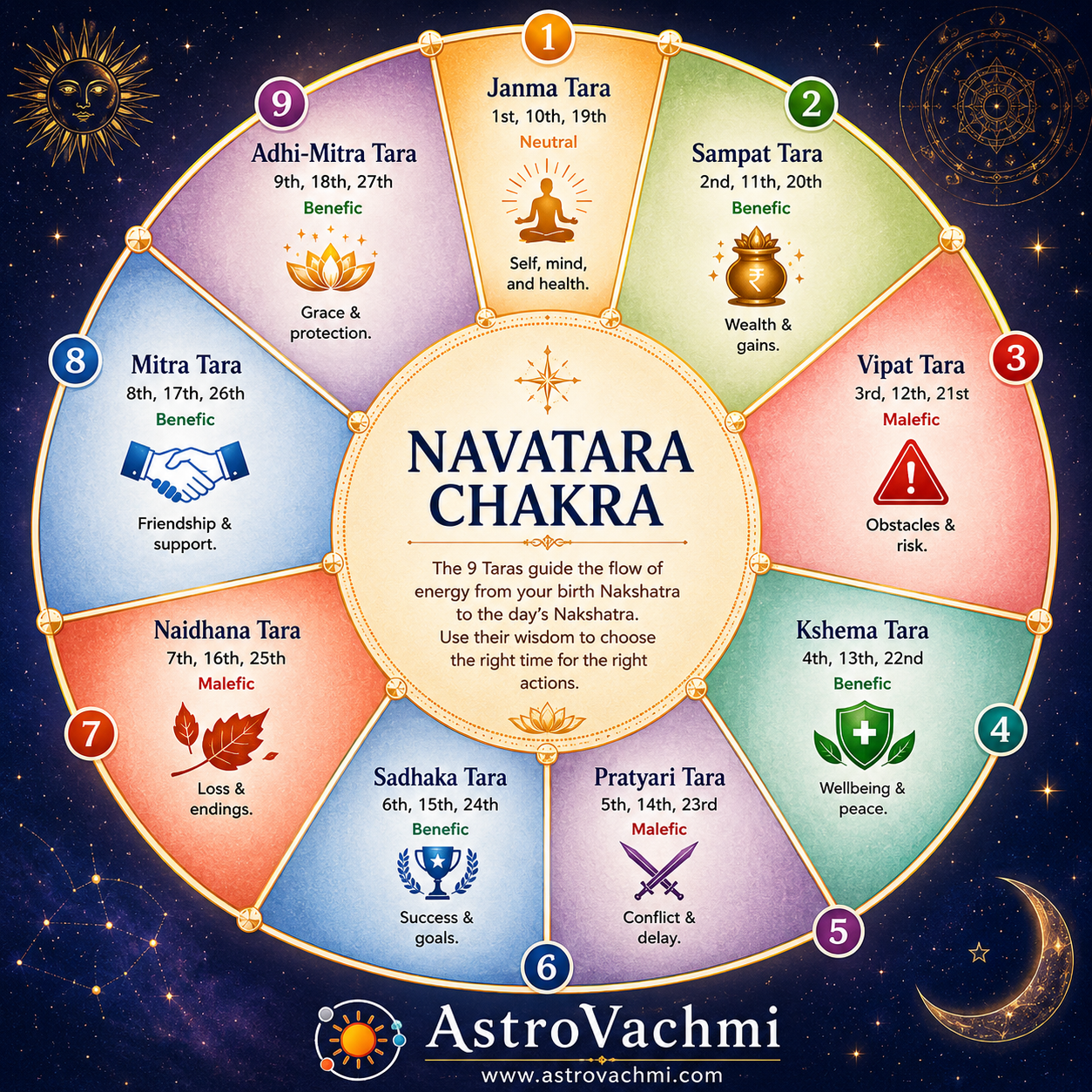
What is Navtara Chakra?
Navtara Chakra, also called Tara Bala Chakra, is one of the oldest and most practical tools in Vedic Astrology (Jyotish). It takes the 27 Nakshatras of the zodiac and groups them into 9 sets of 3, counted forward from your own Janma Nakshatra - the star the Moon occupied at your birth. Because 9 goes into 27 exactly three times, the same 9 Taras repeat across three cycles, giving every one of the 27 Nakshatras a fixed role relative to your birth star.
The 9 Taras at a Glance
| Tara | Counted From Birth Star | Nature | Governs |
|---|---|---|---|
| Janma Tara | 1st, 10th, 19th | Neutral | Self, mind, health |
| Sampat Tara | 2nd, 11th, 20th | Benefic | Wealth & gains |
| Vipat Tara | 3rd, 12th, 21st | Malefic | Obstacles & risk |
| Kshema Tara | 4th, 13th, 22nd | Benefic | Wellbeing & peace |
| Pratyari Tara | 5th, 14th, 23rd | Malefic | Conflict & delay |
| Sadhaka Tara | 6th, 15th, 24th | Benefic | Success & goals |
| Naidhana Tara | 7th, 16th, 25th | Malefic | Loss & endings |
| Mitra Tara | 8th, 17th, 26th | Benefic | Friendship & support |
| Adhi-Mitra Tara | 9th, 18th, 27th | Benefic | Grace & protection |
How the 9 Taras Are Meant
- Janma Tara: Your own birth constellation - it colours identity, temperament, and health rather than pushing events in either direction.
- Sampat Tara: Linked to Sampada (prosperity), this star favours money matters, new resources, and material gain.
- Vipat Tara: Named for Vipada (danger), it is associated with setbacks, accidents, and avoidable risk - a period to move carefully rather than start something new.
- Kshema Tara: The star of wellbeing - supportive for health decisions, healing, and strengthening close relationships.
- Pratyari Tara: Connected to opposition and rivalry, it tends to surface friction with others and is best met with patience rather than confrontation.
- Sadhaka Tara: The achievement star - well suited to career moves, exams, competitions, and anything aimed at a concrete goal.
- Naidhana Tara: The most cautioned-against Tara, tied to loss, illness, or an ending of some kind; auspicious starts are generally avoided here.
- Mitra Tara: The friendship star - favourable for partnerships, teamwork, and building or renewing a support network.
- Adhi-Mitra Tara: Considered the most benevolent of the nine, associated with protection, goodwill, and blessings from genuine well-wishers.
Practical Uses of Navtara Chakra
Beyond the basic meanings, Jyotish uses this framework in several practical ways:
- Dasha results: A planet's dasha tends to unfold more smoothly when that planet sits in a friendly Tara counted from your Janma Nakshatra, and more roughly when it falls in an unfavourable one.
- Transit (Gochara) timing: As the Moon or any planet moves through the sky, its current Nakshatra - counted from your birth star - shows whether that transit is likely to run smoothly (Sampat, Kshema, Sadhaka, Mitra, Adhi-Mitra) or roughly (Vipat, Pratyari, Naidhana).
- Muhurta (auspicious timing): Before starting something important, the Moon's Nakshatra on that day is checked against the native's Tara Bala, alongside the star's own significations.
- Compatibility: In Nakshatra-based matchmaking, a partner's birth star should not fall in Vipat, Pratyari, or Naidhana Tara from your own.
How to Use Navtara Chakra in Astrology?
The two areas where Navtara Chakra earns its keep in day-to-day chart reading are Dasha analysis and transit (Gochara) analysis - both come down to the same question: which Tara, counted from your Janma Nakshatra, is a given planet sitting in right now?
Dasha Analysis: During a planet's Mahadasha or Antardasha, its own placement relative to your birth star colours the flavour of that period. A planet resting in Sampat, Kshema, Sadhaka, Mitra, or Adhi-Mitra Tara tends to deliver its dasha results with relatively less friction, while one placed in Vipat, Pratyari, or Naidhana Tara usually means the same period asks for more effort or brings avoidable setbacks before things improve.
Example: Suppose Jupiter occupies the 7th Nakshatra counted from someone's Janma Nakshatra - that puts it in Naidhana Tara. That person's Jupiter Mahadasha may then run into health scares, disappointments, or a sense of things ending rather than beginning, even though Jupiter is normally a generous planet. Contrast that with Mercury sitting in the 2nd Nakshatra from birth star (Sampat Tara) - a Mercury dasha here tends to favour income, communication-driven work, and general resourcefulness.
Transit (Gochara) Analysis: The same logic applies to a planet's current sky position, not just its natal placement. When a slow-moving planet like Saturn or Rahu moves into the Nakshatra that falls in your Vipat, Pratyari, or Naidhana Tara, that transit window is generally treated as testing - a time to be cautious rather than to launch something new. When a benefic transits into your Sampat, Sadhaka, Mitra, or Adhi-Mitra Tara instead, it is read as a genuinely supportive window.
Example: If Saturn transits into the Nakshatra that is your Adhi-Mitra Tara (9th from your Janma Nakshatra), that stretch of the transit tends to bring steady support, disciplined progress, and well-wishers showing up at the right time - a far gentler face of Saturn than usual. If Rahu instead moves into your Vipat Tara (3rd from birth star), expect a bumpier few weeks - confusion, impulsive decisions, or minor accidents are more likely, and it is wiser to slow down than push forward.
Putting it together, the steps are:
Dasha Analysis: During a planet's Mahadasha or Antardasha, its own placement relative to your birth star colours the flavour of that period. A planet resting in Sampat, Kshema, Sadhaka, Mitra, or Adhi-Mitra Tara tends to deliver its dasha results with relatively less friction, while one placed in Vipat, Pratyari, or Naidhana Tara usually means the same period asks for more effort or brings avoidable setbacks before things improve.
Example: Suppose Jupiter occupies the 7th Nakshatra counted from someone's Janma Nakshatra - that puts it in Naidhana Tara. That person's Jupiter Mahadasha may then run into health scares, disappointments, or a sense of things ending rather than beginning, even though Jupiter is normally a generous planet. Contrast that with Mercury sitting in the 2nd Nakshatra from birth star (Sampat Tara) - a Mercury dasha here tends to favour income, communication-driven work, and general resourcefulness.
Transit (Gochara) Analysis: The same logic applies to a planet's current sky position, not just its natal placement. When a slow-moving planet like Saturn or Rahu moves into the Nakshatra that falls in your Vipat, Pratyari, or Naidhana Tara, that transit window is generally treated as testing - a time to be cautious rather than to launch something new. When a benefic transits into your Sampat, Sadhaka, Mitra, or Adhi-Mitra Tara instead, it is read as a genuinely supportive window.
Example: If Saturn transits into the Nakshatra that is your Adhi-Mitra Tara (9th from your Janma Nakshatra), that stretch of the transit tends to bring steady support, disciplined progress, and well-wishers showing up at the right time - a far gentler face of Saturn than usual. If Rahu instead moves into your Vipat Tara (3rd from birth star), expect a bumpier few weeks - confusion, impulsive decisions, or minor accidents are more likely, and it is wiser to slow down than push forward.
Putting it together, the steps are:
- Identify your Janma Nakshatra (birth star).
- Count forward to find which of the 9 Taras the planet or transit Nakshatra in question falls into.
- Read that Tara's nature (benefic, malefic, or neutral) alongside the planet's own natural signification.
- Weigh it together with the planet's dasha or transit timing to judge whether that period favours action or caution.
Summary
Navtara Chakra turns the 27 Nakshatras into a personal map, showing which stars support you and which call for caution, simply by counting from your own birth star. It is a light but genuinely useful layer to add on top of your Birth Chart analysis and daily Transits - and a good starting point whenever you are weighing the right day to begin something.
Want a reading tailored to your own chart? Connect with an AstroVachmi astrologer to go through your Navtara Chakra and its current relevance in detail.
Want a reading tailored to your own chart? Connect with an AstroVachmi astrologer to go through your Navtara Chakra and its current relevance in detail.
People Also Ask
Your Janma Tara is simply your own birth Nakshatra - the constellation the Moon occupied at the time of your birth. Every other Tara in your Navtara Chakra is counted starting from this star. Use the Chandra Bal & Tara Bal Calculator if you're not sure which Nakshatra is yours.
Yes, the two terms are used interchangeably. Navtara Chakra describes the full wheel of 9 Taras repeated across all 27 Nakshatras, while Tara Bala refers to the strength or quality a specific day, transit, or placement carries because of the Tara it falls into.
Vipat, Pratyari, and Naidhana Tara are generally treated as unfavourable. Important new beginnings - weddings, launches, travel, big purchases - are usually avoided when the Moon transits these stars counted from your birth Nakshatra.
Explore more Astrology articles