

Is Astrology Real? Science, Tradition, and the Stars
The Question Everyone Asks
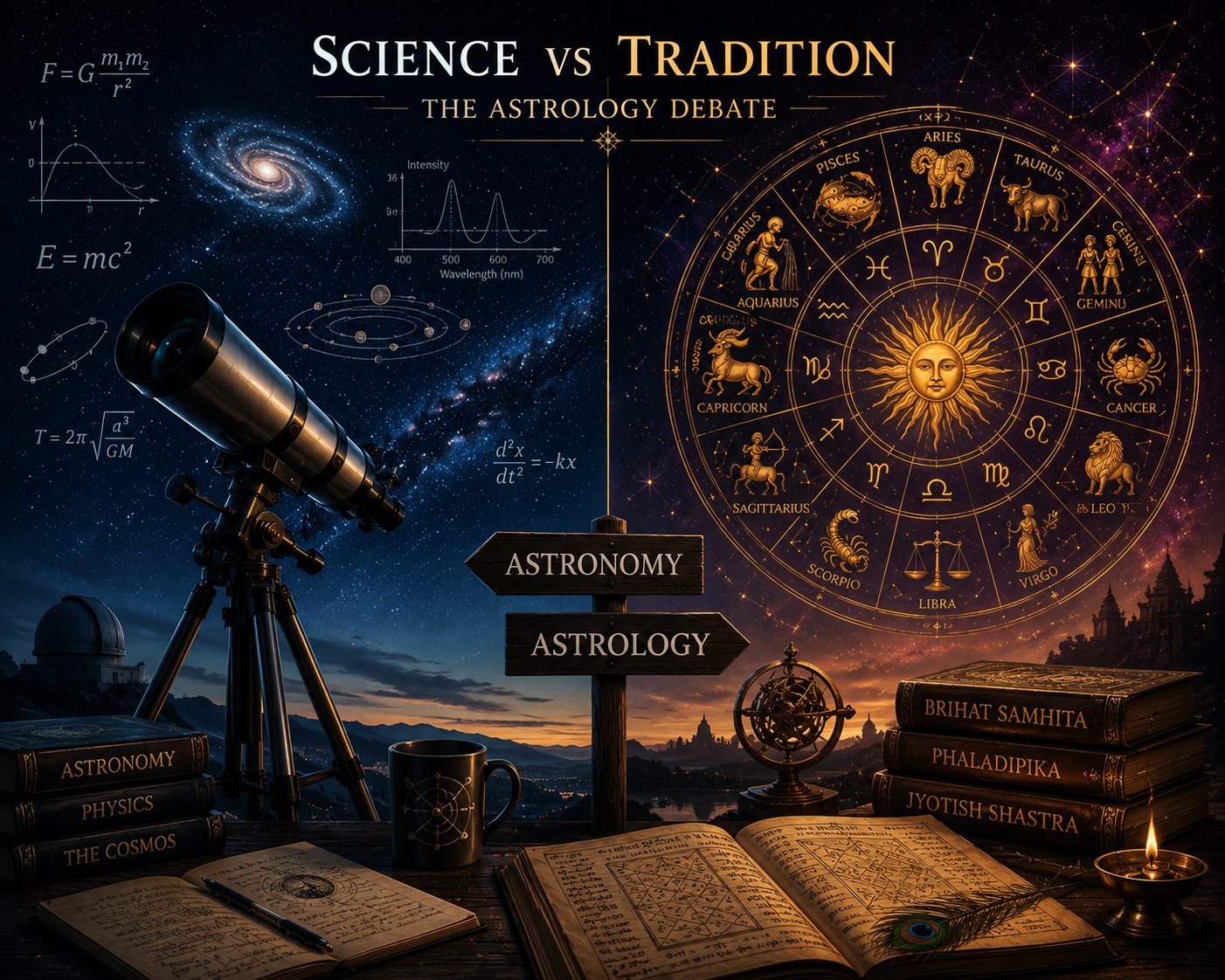
"Is astrology real?" is one of the most searched questions on the internet—and for good reason. Astrology occupies a fascinating space between ancient wisdom and modern skepticism. It is embraced by millions, dismissed by scientists, and yet continues to grow in cultural influence. The honest answer is: it depends entirely on what you mean by "real."
What Science Says — and What It Missed
The most frequently cited scientific challenge to astrology is the Shawn Carlson double-blind test, published in Nature in 1985. It is important to understand what this study actually tested—and what it did not.
The participating astrologers were exclusively from the Western astrological tradition, nominated by the National Council for Geocosmic Research (NCGR) in the United States and Europe. Vedic astrology (Jyotish) was never tested. This distinction matters enormously, because one of the central objections raised against Western astrology—the precession of the equinoxes—is already fully accounted for in the Vedic system. Jyotish uses the sidereal zodiac, anchored to the actual positions of the fixed stars, not the seasonal tropical zodiac used in the West.
Furthermore, the Carlson study itself has been heavily scrutinised. Its design has been criticised for skewed methodology, disregard for its own stated evaluation criteria, and drawing a sweeping conclusion from a null hypothesis—a logical flaw that Professor Suitbert Ertel of Göttingen University demonstrated when he re-analysed the same data and found the astrologers had, in fact, performed at a statistically significant level.
A further limitation of all such tests is that they completely ignore a foundational principle of Vedic astrology: the doctrine of Desh, Kaal, Patra (Place, Time, and the Individual). No prediction in Jyotish is made in a vacuum—the context of the person's geography, the current era, and their unique life circumstances are inseparable from any reading. A test that strips away all context and reduces astrology to chart-matching is not testing astrology as it is actually practised.
The remaining scientific concern—that no known physical mechanism explains planetary influence—is a fair one, though it is worth noting that the absence of a currently understood mechanism is not the same as proof of absence.
The participating astrologers were exclusively from the Western astrological tradition, nominated by the National Council for Geocosmic Research (NCGR) in the United States and Europe. Vedic astrology (Jyotish) was never tested. This distinction matters enormously, because one of the central objections raised against Western astrology—the precession of the equinoxes—is already fully accounted for in the Vedic system. Jyotish uses the sidereal zodiac, anchored to the actual positions of the fixed stars, not the seasonal tropical zodiac used in the West.
Furthermore, the Carlson study itself has been heavily scrutinised. Its design has been criticised for skewed methodology, disregard for its own stated evaluation criteria, and drawing a sweeping conclusion from a null hypothesis—a logical flaw that Professor Suitbert Ertel of Göttingen University demonstrated when he re-analysed the same data and found the astrologers had, in fact, performed at a statistically significant level.
A further limitation of all such tests is that they completely ignore a foundational principle of Vedic astrology: the doctrine of Desh, Kaal, Patra (Place, Time, and the Individual). No prediction in Jyotish is made in a vacuum—the context of the person's geography, the current era, and their unique life circumstances are inseparable from any reading. A test that strips away all context and reduces astrology to chart-matching is not testing astrology as it is actually practised.
The remaining scientific concern—that no known physical mechanism explains planetary influence—is a fair one, though it is worth noting that the absence of a currently understood mechanism is not the same as proof of absence.
Why Astrology Resonates So Deeply
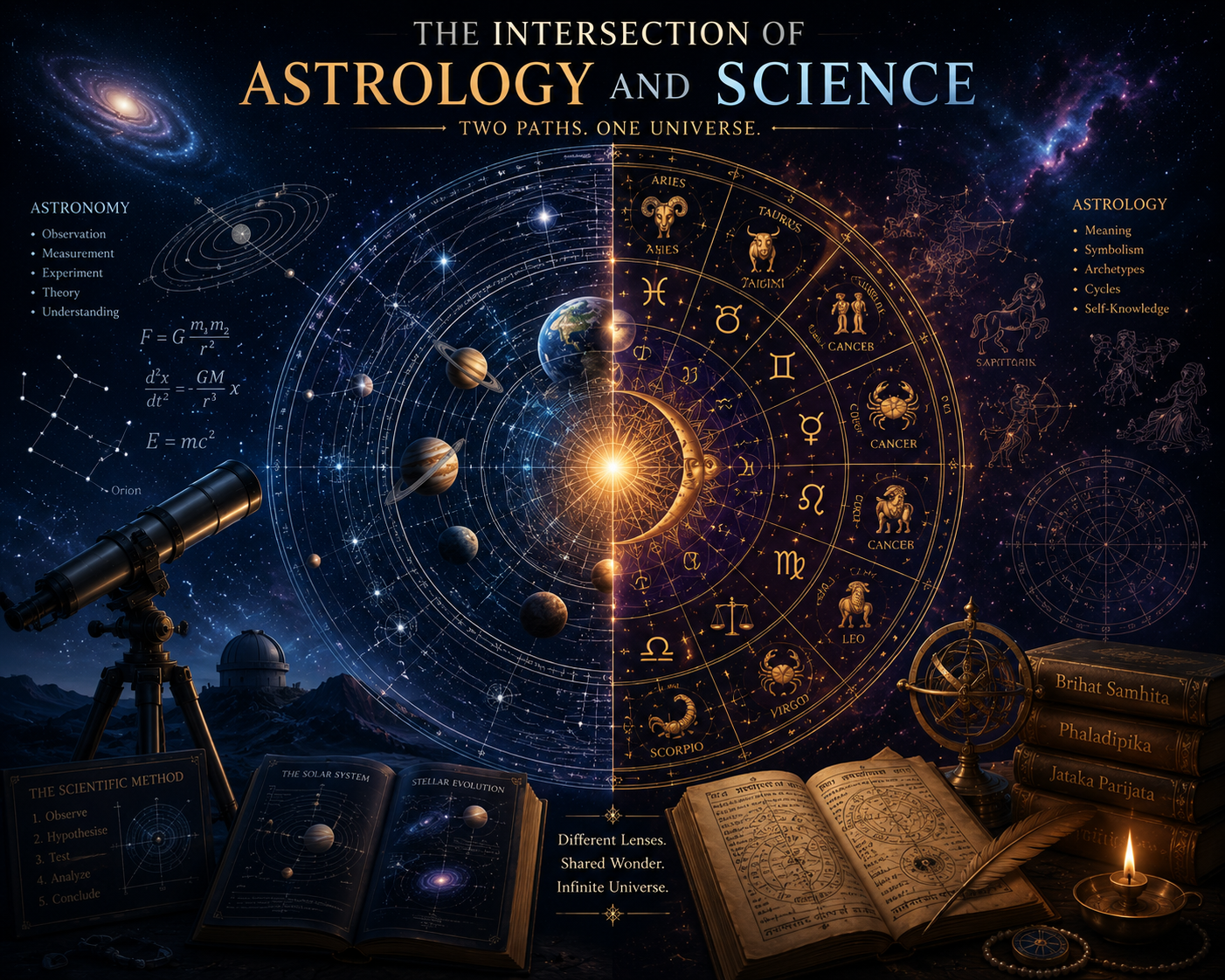
Across cultures and millennia, astrology has endured not because people are gullible, but because it genuinely delivers something of value. Psychology offers some compelling explanations for why this ancient system continues to illuminate modern lives.
- A Mirror for Self-Knowledge: A well-cast and thoughtfully interpreted birth chart holds up a precise mirror to a person's strengths, blind spots, relational patterns, and life themes. The insights it provides often go well beyond what generic personality frameworks can offer, because they are rooted in the unique configuration of the individual's sky at birth.
- Meaning-Making and Cosmic Order: Astrology offers a framework that connects personal experience to a larger cosmic pattern. Knowing that a difficult period coincides with a Saturn transit, or that a time of expansion aligns with Jupiter, gives people a language to understand their own story—not as random suffering or luck, but as a meaningful unfolding. This sense of order has profound and well-documented psychological benefits.
- Guidance Without Determinism: Unlike rigid prediction systems, astrology at its best does not box people in—it opens up awareness. It shows tendencies and potentials, then invites conscious choice. This combination of insight and agency is precisely what makes it a lasting tool for growth rather than a mere curiosity.
- Archetypal Psychology: Astrology's symbols—the pioneering Aries, the nurturing Cancer, the transformative Scorpio—map directly onto the deep archetypes of the human psyche. Carl Jung, the father of analytical psychology, studied astrology seriously and saw in it a sophisticated language for the inner world. For Jung, the planets were not superstitions but living symbols of forces that operate within every human being.
The Depth of Vedic Astrology: Beyond Signs
Vedic Jyotish in particular operates at a level of granularity that Sun-sign astrology cannot approach. Crucially, it does not rely on zodiac signs alone. The system incorporates the 27 Nakshatras—the lunar mansions or star constellations—each spanning 13°20' of the sky and carrying its own ruling deity, planetary lord, and karmic signature.
Beyond the Nakshatras, Vedic astrology employs 16 Divisional Charts (known collectively as the Shodashvarga), each derived from the birth chart by dividing each zodiac sign into progressively finer equal parts. Where the birth chart (D-1) gives the broad overview of a person's life, each divisional chart acts as a magnifying lens for a specific domain: the Navamsa (D-9) for marriage and dharma, the Dasamsa (D-10) for career and public life, the Saptamsa (D-7) for children, the Dwadasamsa (D-12) for parents and ancestry, and the Shashtiamsa (D-60)—dividing each sign into 60 parts of just 0.5°—for past-life karma. A planet that appears strong in the birth chart may be weakened in a relevant divisional chart, substantially altering predictions for that area of life. No serious Jyotish reading considers the birth chart in isolation.
Two people born under the same Moon sign can have entirely different psychological profiles, relationship patterns, and life trajectories depending on which Nakshatra their Moon occupies. Add to this the Vimshottari Dasha timing system and the principle of Desh-Kaal-Patra, and you have a framework of remarkable sophistication.
Krishnamurti Paddhati (KP astrology) takes precision even further, dividing each Nakshatra into nine further unequal subdivisions called Subs—each governed by a Sub Lord whose span varies proportionally with the Vimshottari Dasha years of the ruling planet, ranging from under 1° to just over 2°. At this level of resolution, even two people born minutes apart can have meaningfully different Sub Lords, yielding distinct life outcomes. This level of precision—rooted in actual stellar positions, not seasonal approximations—is what distinguishes a genuine Jyotish or KP reading from a generic horoscope.
Beyond the Nakshatras, Vedic astrology employs 16 Divisional Charts (known collectively as the Shodashvarga), each derived from the birth chart by dividing each zodiac sign into progressively finer equal parts. Where the birth chart (D-1) gives the broad overview of a person's life, each divisional chart acts as a magnifying lens for a specific domain: the Navamsa (D-9) for marriage and dharma, the Dasamsa (D-10) for career and public life, the Saptamsa (D-7) for children, the Dwadasamsa (D-12) for parents and ancestry, and the Shashtiamsa (D-60)—dividing each sign into 60 parts of just 0.5°—for past-life karma. A planet that appears strong in the birth chart may be weakened in a relevant divisional chart, substantially altering predictions for that area of life. No serious Jyotish reading considers the birth chart in isolation.
Two people born under the same Moon sign can have entirely different psychological profiles, relationship patterns, and life trajectories depending on which Nakshatra their Moon occupies. Add to this the Vimshottari Dasha timing system and the principle of Desh-Kaal-Patra, and you have a framework of remarkable sophistication.
Krishnamurti Paddhati (KP astrology) takes precision even further, dividing each Nakshatra into nine further unequal subdivisions called Subs—each governed by a Sub Lord whose span varies proportionally with the Vimshottari Dasha years of the ruling planet, ranging from under 1° to just over 2°. At this level of resolution, even two people born minutes apart can have meaningfully different Sub Lords, yielding distinct life outcomes. This level of precision—rooted in actual stellar positions, not seasonal approximations—is what distinguishes a genuine Jyotish or KP reading from a generic horoscope.
Astrology's Own Enemy: Half-Baked Practice
It would be dishonest to place all the blame for astrology's poor reputation on its critics. A significant share of the damage has been self-inflicted. Astrology has long been plagued by practitioners who reduce this vast, nuanced science to oversimplified Sun-sign generalisations, sensational predictions, and one-size-fits-all horoscopes published in newspapers.
A practitioner who ignores the Ascendant, the Moon, the Nakshatras, the Dasha periods, and the context of Desh-Kaal-Patra, and then pronounces sweeping verdicts based on the Sun sign alone, is not practising astrology—they are caricaturing it. Such half-baked readings have not only misled countless individuals but have handed skeptics the easiest possible target. The failure of a poorly practised version of astrology is not evidence against the system itself, any more than a bad doctor disproves medicine.
A practitioner who ignores the Ascendant, the Moon, the Nakshatras, the Dasha periods, and the context of Desh-Kaal-Patra, and then pronounces sweeping verdicts based on the Sun sign alone, is not practising astrology—they are caricaturing it. Such half-baked readings have not only misled countless individuals but have handed skeptics the easiest possible target. The failure of a poorly practised version of astrology is not evidence against the system itself, any more than a bad doctor disproves medicine.
A Different Kind of "Real"
Many serious practitioners of both Western astrology and Vedic Jyotish do not claim astrology is a hard science. Instead, they describe it as a symbolic system—a language of patterns and archetypes that, when skillfully interpreted, can provide genuine insight.
In this view, asking "is astrology real?" is like asking "is music real?" Music cannot predict the stock market or cure disease, yet it is deeply meaningful, can shift emotions, and reveals truths about human experience. Astrology, for its practitioners, operates in a similar register.
In this view, asking "is astrology real?" is like asking "is music real?" Music cannot predict the stock market or cure disease, yet it is deeply meaningful, can shift emotions, and reveals truths about human experience. Astrology, for its practitioners, operates in a similar register.
Summary
The scientific tests most often cited against astrology tested only a narrow slice of Western Sun-sign practice, ignored the sophisticated framework of Vedic Jyotish entirely, and have since been found methodologically wanting. None of this makes astrology a hard science—but it does mean the case against it is far weaker than popular culture assumes.
The wisest approach is to engage with astrology—especially the deeper traditions of Jyotish—as a tool for self-knowledge, pattern recognition, and conscious living. Seek out practitioners who honour the full system: Nakshatras, Dashas, and the irreplaceable context of Desh, Kaal, and Patra. That is where astrology's true depth reveals itself.
The wisest approach is to engage with astrology—especially the deeper traditions of Jyotish—as a tool for self-knowledge, pattern recognition, and conscious living. Seek out practitioners who honour the full system: Nakshatras, Dashas, and the irreplaceable context of Desh, Kaal, and Patra. That is where astrology's true depth reveals itself.
Explore more Astrology articles