

The Vedas are the oldest sacred texts and are still studied and followed today. They are also the richest and most comprehensive body of texts that over the centuries have inspired scholars to interpret their true meaning.
A common question that always pops up in the minds of readers is 'Who are Vedic Gods?'.
The first impression that one gets after reading Vedas is that the Gods being praised are Gods like Indra, Agni, Varun, Vayu, Ushas, Surya, Rudra, Kuber, Pushan etc. Vedas are full of hymns praising these Gods. All these Gods are connected to natural phenomena that we observe in nature. These are the Gods which a human being can feel and experience as they all symbolize some physical events and entities.
Vedic Gods
Vedic Goddesses
Journey from visible to invisible
So, were the Vedic people curious about the natural events like rain, lightning, wind, rising of Sun every day? Were they in awe of these natural phenomena? Is that the reason they personified these events as Gods? The answer is Yes and No.
Yes, because they believed that these events cannot happen on their own and there is a force behind them which regulate them all. Hence they attributed each of these phenomenon to various Gods.
No, because there is more to it than meets the eye.
When we call Indra, Agni, Vayu, Varun, Earth etc. as the only Gods in Vedas, we are overlooking overwhelming messages which say:
The following verse (ṛc) appears in Rigveda, Atharvaveda and Yajurveda with some minor variations. But gives the same message.
यो देवानां नामधाSएकSएव तं सं प्रश्नं भुवना यन्त्यन्या ॥ १०.८२.३ ॥
One more verse (ṛc) from Rigveda is unequivocal about this fact.
एकं सद्विप्रा बहुधा वदन्त्यग्निं यमं मातरिश्वानमाहुः॥ १.१६४.४६ ॥
And there are hundreds of lines in the four Vedas which point to this one eternal fact that there is no one else other than Him who rules this world.
He is the Brahman (ब्रह्मन्) – one that goes beyond the purview of temporality, one that is eternal and the source of everything. Brahman is omnipresent, in the realm of materiality, penetrating the whole of reality as the essence that provides the structure, meaning and existence to everything, and yet, Brahma is the transcendent origin of all these things. Thus, Brahman is said to be panentheistic (pan (all) - en (in) - theistic (God)).
Brahman is primeval and the only reality that truly exists. Everything else is just a contingent transformation of Brahma, or substitute of the attributive dependence on Brahma.
But if this is the case and if Vedas point to Brahma (ब्रह्म) as the ultimate goal that one should seek then why Vedas are full of praise for other deities? Why did they not praise and seek Brahma directly instead of praising these Gods?
Pandit Shripad Damodar Satvalekar gives a beautiful analogy to explain the reason behind this in his book Atharvaved Brahmavidya Prakaran and it goes like this:
When you meet your friend and greet him, do you greet his soul or his body?
You cannot see his soul, you cannot touch his soul. So how can you greet it?
If you give it some thought, you will realize that you greet his body.
If you really believe that you greet his body, think one more time.
Would you greet if you see his dead body? Would you say hello to his soulless body?
The answer is 'No'.
Confused?
The fact here is that physical body and organs are physical entities and we can touch and see them. Life is invisible but you can still experience it through breathing (respiration) of a person. Mind, wisdom are also invisible. However, one can still relate to mind and wisdom through an individual's acts and deeds. But soul remains invisible all the time.
Life is situated midway between Visible and Invisible, it connects macro (visible) to subtle (invisible).
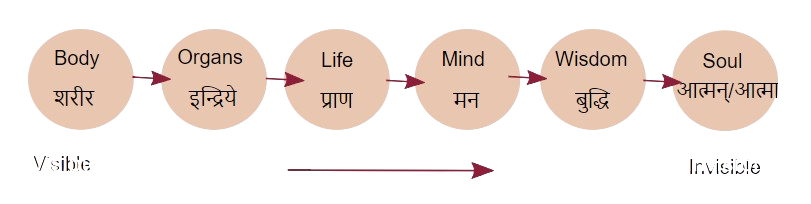
People unaware of this logic will typically believe that they greet the physical and visible body. But people who understand this concept well would greet their friends with this understanding of Life situated within the body.
An important aspect that needs to be understood here is that till the soul does not manifest itself into a physical entity/reality, it is not possible to experience it. It is necessary to have a medium called body to reach one's soul. The physical entity is only for the namesake. But it is a necessary medium to reach the invisible (अदृश्य) and indirect (अप्रत्यक्ष).
In the same way, to reach Brahma, who is invisible (अदृश्य) and indirect (अप्रत्यक्ष), there has to be a medium which is visible and experiential. As we cannot see Brahma directly, he can only be experienced through visible media and probably through 'larger than life' things like Sun's radiance and heat, the gusty winds during hurricanes and typhoons and the powerful rivers and the vastness of the universe that we know today.
These physical entities are the media which we have with us to seek Him.
This is exactly what Vedic people may have thought. They praised those who are 'visible' in order to reach the one who is 'invisible' and 'indirect'. They praised Indra, Agni, Varun, Vayu and others as media to reach that Supreme Being - The Brahman (ब्रह्मन्), The Paramatma (परमात्मा).